
A weekly cleaning schedule for working adults has three layers. The first is a few habits you keep every day or after each use: dishes, food-prep counters and the dryer lint filter. The second is eight weekly jobs, such as sheets, vacuuming, dusting and the toilet, which you can spread over weekday evenings or do in one weekend block. The third is four monthly jobs, one per weekend.
For scale, employed adults in the US spent an average of 25 to 28 minutes a day on housework in 2025, about 3 hours a week, not counting kitchen clean-up, according to the Bureau of Labor Statistics (BLS).
What goes on a weekly cleaning schedule?
The table lists every job in the schedule, how often its source says to do it, and where it sits in our sample week. Most rows come from Consumer Reports' cleaning schedule, last updated in 2018; the rest come from the EPA, Which?, the UK Food Standards Agency, U.S. fire-safety bodies, ENERGY STAR and Samsung. For 31 chores room by room, and which numbers are official, see our chart of how often to clean everything in your home.
| Job | How often | Source | Slot in the sample week |
|---|---|---|---|
| Every day or after each use | |||
| Dishes | After each meal (load the dishwasher or wash by hand) | Consumer Reports | Daily habit |
| Food-prep counters and chopping boards | Clean before you prepare food; wash chopping boards soon after raw food | UK Food Standards Agency | Daily habit |
| Kitchen sink, cooking surfaces, bathroom sink and shower | Wipe or clean after each use | Consumer Reports | Daily habit |
| Bed and clothes | Make the bed and pick up clothes daily | Consumer Reports | Daily habit |
| Kitchen garbage | Empty daily | Consumer Reports | Daily habit |
| Dryer lint filter | Every load (fire-safety advice) | U.S. Fire Administration; NFPA | Every load |
| Every week | |||
| Toilet | A thorough clean once a week (family home of about five) | Which? (British Cleaning Council) | Monday |
| Bathroom basins, fixtures and floor | Weekly | Consumer Reports | Monday |
| Vacuum rugs, floors and upholstered furniture | Weekly | EPA; Consumer Reports | Tuesday |
| Kitchen: burners, fridge, cabinet fronts, floor | Weekly | Consumer Reports | Wednesday |
| Dust furniture, shelves and mirrors | Weekly (EPA: dust often, with a damp cloth) | Consumer Reports; EPA | Thursday |
| Wastebaskets | Empty weekly | Consumer Reports | Thursday |
| Sheets and pillowcases | Weekly; Which? says at 60°C (140°F) for most fabrics | Which?; EPA | Saturday |
| Laundry | Weekly | Consumer Reports | Saturday |
| Every month | |||
| Furnace or HVAC filter | Check monthly; change at least every 3 months | ENERGY STAR | Weekend 1 |
| Washing machine | Samsung washers: cleaning cycle once a month; front-loader pump filter at least monthly or about every 40 washes, whichever comes first | Samsung | Weekend 2 |
| Curtains, drapes and blinds | Monthly: vacuum or brush curtains and drapes; dust or brush blinds | Consumer Reports | Weekend 3 |
| Under and around furniture and appliances | Monthly | Consumer Reports | Weekend 4 |
How much time do working adults spend on housework?
About 25 to 28 minutes a day: that is what employed adults in the US averaged in 2025 (BLS American Time Use Survey). BLS reports this for all employed adults; the tables in its 2025 release do not split housework by full- or part-time work. In that survey, employed adults with no children under 18 at home averaged 0.42 hours of housework a day, and employed adults with children under 18 averaged 0.47 hours. Those averages cover every day of the week, and they include people who did no housework that day.
| Employed adults, 18 and over | Hours a day (BLS) | Minutes a day | Hours a week (our calculation, × 7) |
|---|---|---|---|
| No household children under 18 | 0.42 | 25 | 2.9 |
| Household children under 18 | 0.47 | 28 | 3.3 |
BLS counts interior cleaning, laundry, sewing and putting household items away as housework. Kitchen clean-up is counted separately, under food preparation and cleanup: washing dishes and clearing the table, but also cleaning the stove, oven, fridge and kitchen cupboards and mopping the kitchen floor. So most of the kitchen jobs in this schedule, from the dishes to the weekly burners, fridge and floor, come on top of these figures.
Weekends carry more of it. Across everyone 15 and over, 39.6 percent did some housework on an average weekend day or holiday, against 34.7 percent on a weekday, and those who did it spent 1.78 hours against 1.44 hours (BLS, 2025). That matches the working week: 81 percent of employed people worked on an average weekday, compared with 30 percent on an average weekend day. These are averages of what people did, not the time a clean home needs.
A sample week: a little each weekday, or one weekend block
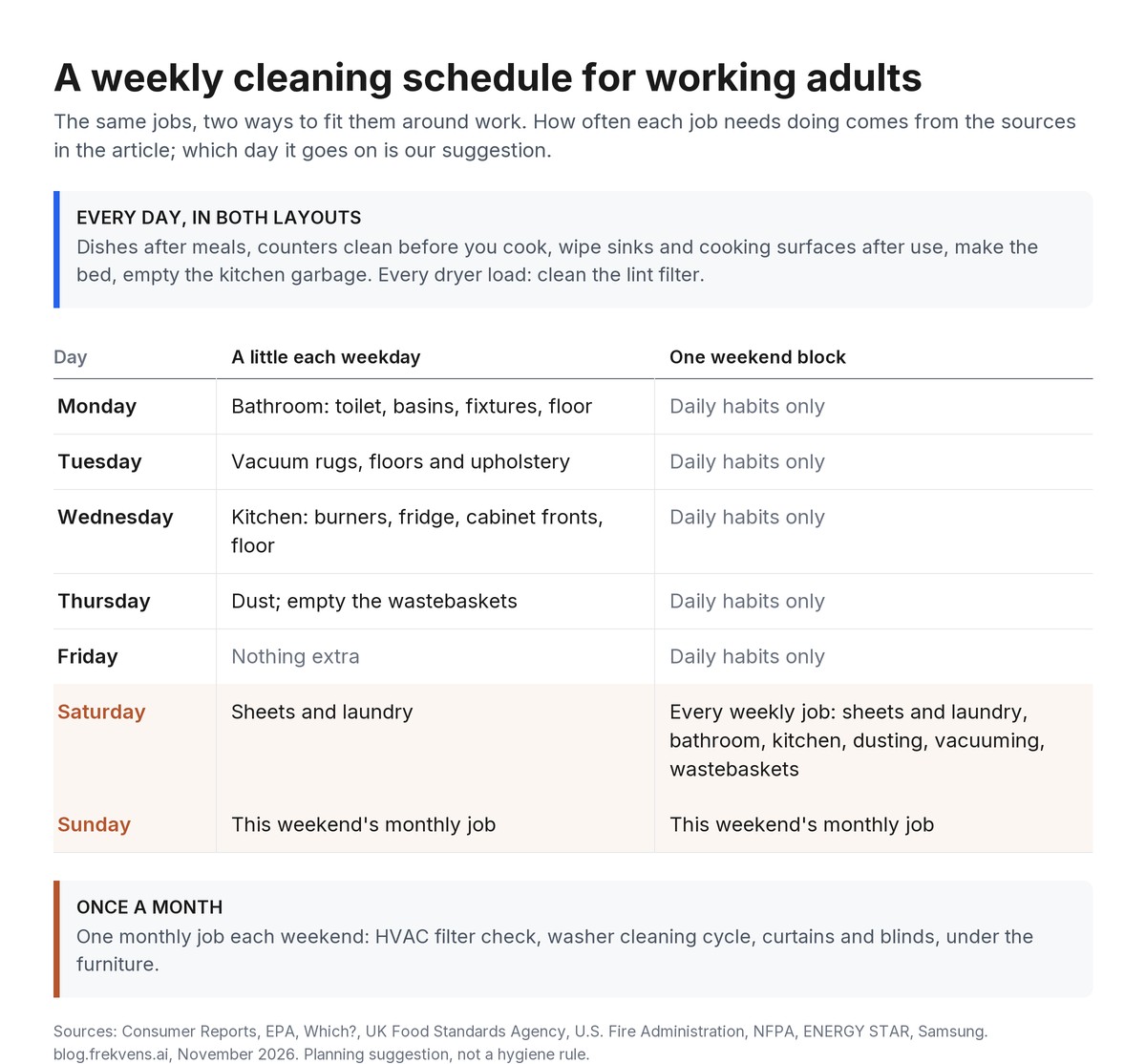
Both layouts cover the same jobs at the same frequencies; only the days differ. The days are our suggestion, not a rule. The weekday version gives Monday to Thursday one area each (the bathroom, vacuuming, the kitchen, then dusting and the wastebaskets), puts sheets and laundry on Saturday, and leaves Friday free. The weekend version keeps weekday evenings to the daily habits and does every weekly job on Saturday.
| Day | A little each weekday | One weekend block |
|---|---|---|
| Monday | Bathroom: toilet, basins, fixtures, floor | Daily habits only |
| Tuesday | Vacuum rugs, floors and upholstery | Daily habits only |
| Wednesday | Kitchen: burners, fridge, cabinet fronts, floor | Daily habits only |
| Thursday | Dust; empty the wastebaskets | Daily habits only |
| Friday | Nothing extra | Daily habits only |
| Saturday | Sheets and laundry | Every weekly job: sheets and laundry, bathroom, kitchen, dusting, vacuuming, wastebaskets |
| Sunday | This weekend's monthly job | This weekend's monthly job |
Sunday holds one monthly job. On the first weekend, check the furnace or HVAC filter; ENERGY STAR says to check it every month and change it at least every 3 months. On the second, run the washing machine's cleaning cycle; Samsung recommends the Self Clean cycle on its washers once a month, and on its front-loaders it says to clean the pump filter at least monthly or about every 40 washes, whichever comes first.
On the third, vacuum or brush the curtains and blinds, and on the fourth, clean under and around furniture and appliances (Consumer Reports). A fifth weekend in a month has nothing scheduled.
Which cleaning jobs can't wait for the weekend?
The dryer lint filter and food-prep surfaces. The U.S. Fire Administration says to clean the lint filter before and after each cycle, and the National Fire Protection Association (NFPA) says before or after each load; the NFPA names failure to clean dryers as the leading cause of home clothes dryer fires. The UK Food Standards Agency says to make sure surfaces you use for food preparation are clean, and to wash chopping boards soon after preparing raw food. Consumer Reports adds dishes after each meal and a wipe of sinks and cooking surfaces after each use, which is why they sit with the daily habits rather than on a weekend.
What does our app's default schedule add up to?
About 35 chores a week, or 5 a day. Dustly (our app), a cleaning-schedule app for iPhone and iPad, starts a new home from a built-in template of 41 chores in 7 rooms, as of version 1.3. It pre-selects three rooms, Kitchen, Bathroom and Bedroom, with 23 chores between them.
Each chore has a default interval in days; a chore every 3 days comes round 7 ÷ 3, or about 2.3, times a week. Summed over the 23 chores, that is 35.1 a week.
| Default interval | Chores in the template | Times a week |
|---|---|---|
| Every day | Wash the dishes, Make the bed | 14.0 |
| Every 2 to 3 days | Wipe the counters, Take out the rubbish, Clean the hob, Wipe the sink | 10.5 |
| Every week | Scrub the sink, Mop the kitchen floor, Clean the toilet, Scrub the shower, Change the towels, Mop the bathroom floor, Clear the nightstand, Vacuum the bedroom | 8.0 |
| Every 2 weeks | Clean the mirror, Wash the bath mat, Change the sheets, Dust the surfaces | 2.0 |
| Monthly or less often | Clear out the fridge, Descale the kettle, Clean the oven, Descale the shower head, Clean under the bed | 0.6 |
| Total: 23 chores | Kitchen, Bathroom, Bedroom | 35.1 |
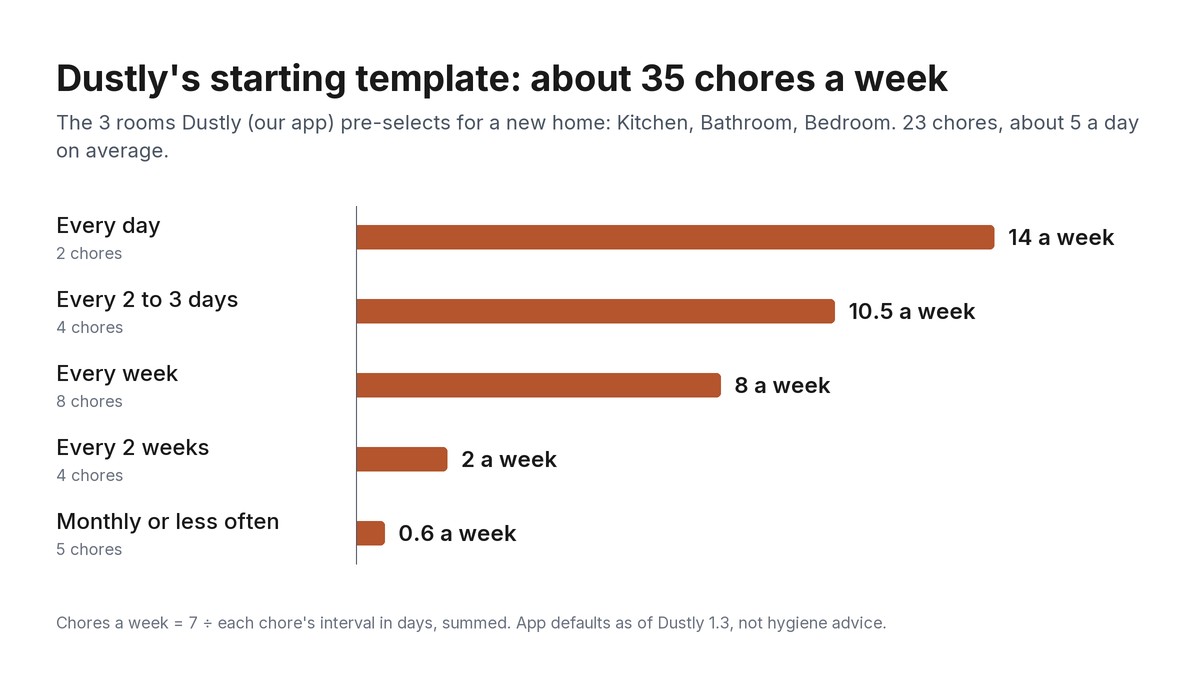
The daily and every-2-to-3-days chores make up 24.5 of the 35.1 a week, so most of a week's chores are small and frequent. Many of the defaults are looser than the guidance in the first table. Where that table says every day or after each use, the defaults in Dustly (our app) are every 2 or 3 days for Wipe the counters, Clean the hob, Wipe the sink and Take out the rubbish, and weekly for Scrub the sink and Scrub the shower. Change the sheets, Dust the surfaces and Clean the mirror come back every 14 days, where Which? and the EPA say weekly for bedding and Consumer Reports says weekly for dusting furniture and mirrors; Clean under the bed comes back every 60 days, where Consumer Reports says monthly.
Any interval can be set from 1 to 730 days. The Today list in Dustly (our app) shows a day's share of about five chores that are ready, in line with the average of about 5 a day.
For a working week, the setting that matters in our app is quiet days, added in version 1.3: you pick the days you never clean, and on those days the app shows no list and sends no reminder, and anything that comes due waits for your next open day. Quiet days change only what the app asks of you; the dishes and the lint filter still need doing.
Questions people ask
Do employed men and women do the same amount of housework?
No, on average. In 2025, employed women with no children under 18 at home averaged 0.61 hours of housework a day and employed men 0.25 hours; with children under 18, the figures were 0.70 and 0.27 hours (BLS American Time Use Survey).
Do you need to disinfect your home every week?
Not usually. The CDC says sanitizing or disinfecting at home is likely not needed unless someone in the home is sick, and it says to disinfect, as well as clean, when someone is sick or at higher risk of getting sick because of a weakened immune system. It says to clean high-touch surfaces, such as light switches, doorknobs and countertops, regularly and after visitors.
Can you mix cleaning products to save time?
No. The CDC says not to mix products or chemicals with each other, to follow the directions on the label, and to keep the room ventilated, for example by opening windows.
How often should you clean the dryer vent?
Once a year, the NFPA says, or more often if clothes take longer than normal to dry: clean the lint out of the vent pipe, or have a dryer lint removal service do it.
Sources
- U.S. Bureau of Labor Statistics — American Time Use Survey, 2025 results (news release, June 25, 2026), checked November 5, 2026
- U.S. Bureau of Labor Statistics — ATUS table 2: weekdays and weekends, 2025, checked November 5, 2026
- U.S. Bureau of Labor Statistics — ATUS table 8B: employed adults, 2025, checked November 5, 2026
- U.S. Bureau of Labor Statistics — ATUS 2025 news release, table of contents, checked November 5, 2026
- U.S. Bureau of Labor Statistics — ATUS technical note, checked November 5, 2026
- U.S. Bureau of Labor Statistics — ATUS activity lexicon 2025 (PDF), checked November 5, 2026
- Consumer Reports — A Cleaning Schedule You Can Stick To (2018), checked November 5, 2026
- EPA — Asthma Triggers: Gain Control, checked November 5, 2026
- CDC — When and How to Clean and Disinfect Your Home, checked November 5, 2026
- UK Food Standards Agency — Why is cleaning important, checked November 5, 2026
- Which? — How often should you wash your bedding?, checked November 5, 2026
- Which? — Expert tips on how to clean your toilet, checked November 5, 2026
- U.S. Fire Administration — Clothes Dryer Fire Safety (PDF), checked November 5, 2026
- NFPA — Clothes Dryer Safety tip sheet (PDF), checked November 5, 2026
- ENERGY STAR — Heat & Cool Efficiently, checked November 5, 2026
- Samsung US — How to clean your Samsung washer, checked November 5, 2026
- Dustly 1.3 built-in starting chores and settings (our app), read from the app's source, November 5, 2026
How this article was made: Written with AI from the sources above, read on November 5, 2026, and checked against them by an automated editorial step; published by Frekvens AI. The Dustly figures come from our app's source code, as of version 1.3; the weekly totals are our own arithmetic from its default intervals, and the hours a week are BLS daily averages multiplied by 7. The choice of days in the sample week is our suggestion. The top image is an AI-generated illustration. No measurements or cleaning tests of our own are used.