
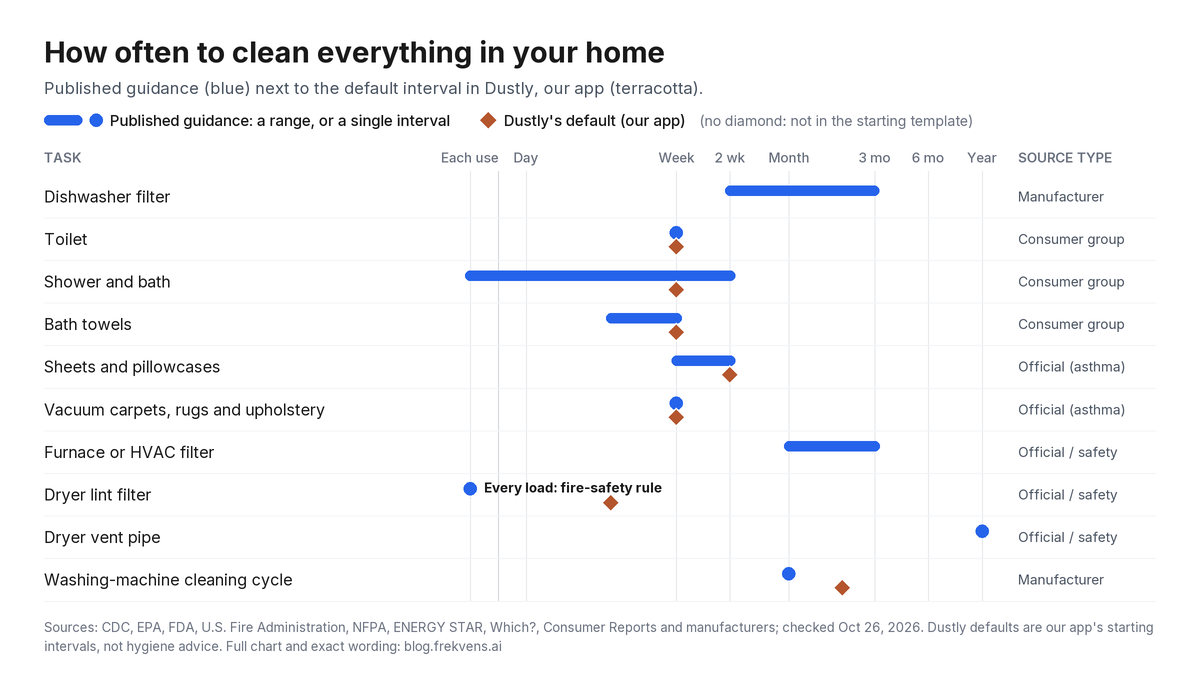
Make sure food-prep counters are clean before you cook and wash chopping boards soon after preparing raw food (UK Food Standards Agency), and clean the dryer lint filter after every load (U.S. fire-safety bodies). The toilet, floors, towels and sheets need about a weekly rhythm, most appliance filters a monthly one, and pillows, duvets and the mattress every 3 to 12 months, according to consumer groups, manufacturers and ENERGY STAR. For most chores no public-health body sets a number, so the chart names who each number comes from.
Room-by-room cleaning chart
Blue marks show the published guidance for 31 household tasks; the right-hand column says what kind of source gives each number.
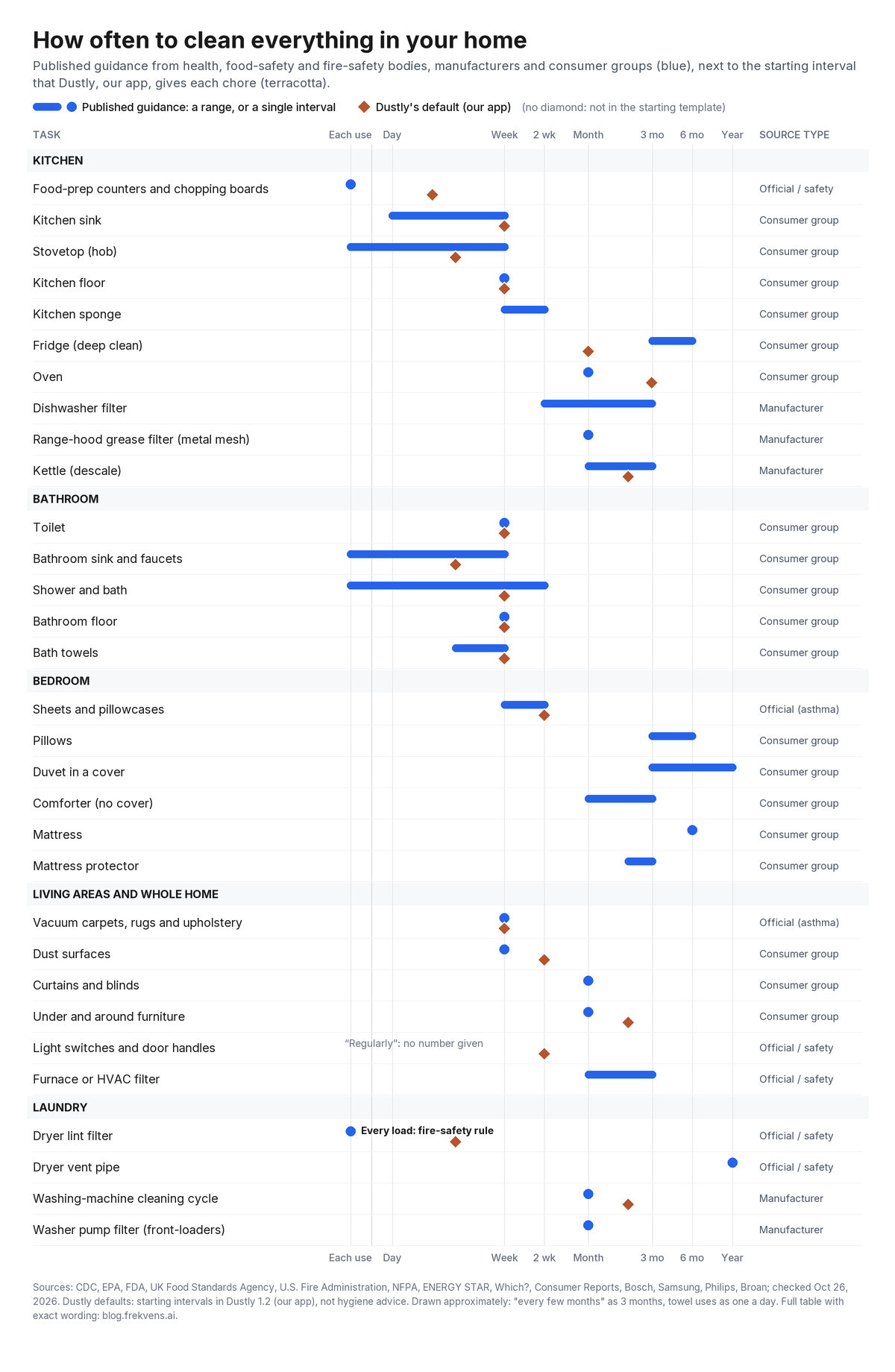
The terracotta diamonds are the starting intervals in Dustly, our cleaning-schedule app for iPhone and iPad, as of version 1.2: app defaults, not hygiene rules. In the table (as of October 2026), "Not in the template" means our app has no starting chore for that task.
| Task | How often (published guidance) | Source | Dustly's default (our app) |
|---|---|---|---|
| Kitchen | |||
| Food-prep counters and chopping boards | Clean before you prepare food; wash chopping boards soon after raw food | UK Food Standards Agency; Consumer Reports | Wipe the counters: every 2 days |
| Kitchen sink | Clear food debris daily; disinfect once or twice a week | Consumer Reports (citing NSF and Charles Gerba, University of Arizona) | Scrub the sink: every 7 days |
| Stovetop (hob) | Wipe after each use; clean the burners weekly | Consumer Reports | Clean the hob: every 3 days |
| Kitchen floor | Sweep or mop weekly | Consumer Reports | Mop the kitchen floor: every 7 days |
| Kitchen sponge | Replace every 1 to 2 weeks; wash dishcloths and sponges regularly and dry them before reuse | Consumer Reports (cleaning expert); UK Food Standards Agency | Not in the template |
| Fridge (deep clean) | Wipe spills at once; deep clean 2 to 4 times a year | FDA; Which? | Clear out the fridge: every 30 days |
| Oven | Wipe down at least once a month | Which?; Consumer Reports | Clean the oven: every 90 days |
| Dishwasher filter | At least every 2 weeks (Bosch UK) to every few months (Bosch US) | Bosch | Not in the template |
| Range-hood grease filter (metal mesh) | About once a month; more often if you fry a lot | Broan | Not in the template |
| Kettle (descale) | Monthly in hard water; every 3 months in soft water | Philips | Descale the kettle: every 60 days |
| Bathroom | |||
| Toilet | A thorough clean once a week (family home of about five) | Which? (British Cleaning Council) | Clean the toilet: every 7 days |
| Bathroom sink and faucets | Wipe after each use; wash weekly | Consumer Reports | Wipe the sink: every 3 days |
| Shower and bath | Squeegee after each shower; wipe the bath and scrub grout every 1 to 2 weeks | Which?; Consumer Reports | Scrub the shower: every 7 days |
| Bathroom floor | Weekly | Consumer Reports | Mop the bathroom floor: every 7 days |
| Bath towels | After 3 to 5 uses if they dry between uses, or once a week | American Cleaning Institute via Consumer Reports; Which? | Change the towels: every 7 days |
| Bedroom | |||
| Sheets and pillowcases | Weekly; at least every 2 weeks | Which?; Consumer Reports; EPA; American Cleaning Institute | Change the sheets: every 14 days |
| Pillows | Every 3 to 6 months (at least twice a year) | Consumer Reports; Which? | Not in the template |
| Duvet in a cover | Every 3 to 6 months (Consumer Reports) to once or twice a year (Which?) | Consumer Reports; Which? | Not in the template |
| Comforter (no cover) | Every 1 to 3 months on a bed used daily | Rich Handel, Consumer Reports' laundry expert | Not in the template |
| Mattress | Clean and refresh every 6 months | Which? | Not in the template |
| Mattress protector | Wash every 2 to 3 months | Which? | Not in the template |
| Living areas and whole home | |||
| Vacuum carpets, rugs and upholstery | Weekly | EPA; Consumer Reports | Vacuum the bedroom, Vacuum the living room: every 7 days (Vacuum the office: every 14 days) |
| Dust surfaces | Weekly, with a damp cloth | Consumer Reports; EPA (“dust often”) | Dust the surfaces, Dust the shelves, Dust the desk and shelves: every 14 days |
| Curtains and blinds | Monthly (vacuum or brush) | Consumer Reports | Not in the template |
| Under and around furniture | Monthly | Consumer Reports | Clean under the bed: every 60 days |
| Light switches and door handles | Regularly and after visitors; more often if people at home are more likely to get sick. No number given | CDC | Wipe the door handles: every 14 days |
| Furnace or HVAC filter | Check monthly; change at least every 3 months | ENERGY STAR | Not in the template |
| Laundry | |||
| Dryer lint filter | Every load (fire-safety rule) | U.S. Fire Administration; NFPA | Clean the dryer lint filter: every 3 days (with the laundry; 1.0 and 1.1: Clean the lint filter, every 14 days) |
| Dryer vent pipe | Once a year; sooner if drying takes longer than normal | NFPA | Not in the template |
| Washing-machine cleaning cycle | Once a month | Samsung | Run a machine clean: every 60 days |
| Washer pump filter (front-loaders) | At least monthly, or every 40 washes if sooner | Samsung | Not in the template |
Which cleaning frequencies are official?
Only a few household jobs have a number from a public-health, food-safety, fire-safety or energy body:
- Dryer lint filter: after every load. The U.S. Fire Administration says before and after each cycle; the National Fire Protection Association (NFPA) says before or after each load.
- Dryer vent pipe: once a year, or sooner if clothes take longer than normal to dry (NFPA).
- Food-prep surfaces: clean before you prepare food, and wash chopping boards soon after preparing raw food (UK Food Standards Agency).
- Furnace or HVAC filter: check every month and change it at least every 3 months (ENERGY STAR).
- Bedding and vacuuming: weekly. The EPA's asthma-trigger guidance on dust mites says to wash bedding in hot water once a week and vacuum carpets and furniture every week.
The CDC says to clean high-touch surfaces such as light switches, doorknobs and countertops regularly and after visitors, and other surfaces when they are visibly dirty or as needed. The FDA says to clean the refrigerator regularly and wipe spills immediately. Neither gives a number. Every other number in the chart comes from a consumer group or a manufacturer's care instructions.
How often should you clean the kitchen?
Food-prep surfaces need to be clean every time you cook, as the UK Food Standards Agency says. Consumer Reports, citing USDA guidelines, says to clean and sanitize the kitchen sink each time you use it for food; citing NSF, it says to disinfect it once or twice a week.
The Food Standards Agency says to wash or change dishcloths, dish towels and sponges regularly; a cleaning expert quoted by Consumer Reports says to replace kitchen sponges every 1 to 2 weeks.
The FDA says to clean the refrigerator regularly and check leftovers daily for spoilage. Which? suggests a full fridge deep clean 2 to 4 times a year, and wiping the oven down at least once a month.
Appliance makers set the rest, and they do not always agree: Bosch UK says to clean the dishwasher filter at least every 2 weeks; Bosch US says every few months. If your own manual gives a number, use that.
Broan says to wash metal-mesh range-hood grease filters about once a month, more often if you fry a lot. Philips says to descale a kettle every month in hard water and every 3 months in soft water.
How often should you clean the bathroom, toilet and shower?
Weekly is the usual answer, but it comes from cleaning experts, not health agencies. Which?, quoting Delia Cannings of the British Cleaning Council, says a thorough toilet clean once a week is enough in a family home of about five people. Consumer Reports' 2018 cleaning schedule says to clean the bathroom sink and shower after each use and to wash basins, fixtures and floors weekly. Which? suggests a squeegee after every shower and wiping the bath and scrubbing the grout every week or two.
The official advice for bathrooms is about mold. The EPA says to run the bathroom fan or open a window when showering, keep indoor humidity below 60 percent (ideally 30 to 50 percent), and dry water-damaged areas and items within 24 to 48 hours. It says to scrub mold off hard surfaces with detergent and water and dry them completely.
For bath towels, Consumer Reports cites the American Cleaning Institute: wash them every 3 to 5 uses if they hang to dry in between. Which? lists one wash a week.
How often should you wash your sheets?
Once a week. Which? says most people should wash bedding covers weekly, at 60°C (140°F) for most fabrics; check the care label for yours. Consumer Reports and the EPA's dust-mite guidance also say weekly, and older American Cleaning Institute advice, quoted by Consumer Reports in 2014, puts the outer limit at every 2 weeks, more often if you sweat a lot.
Pillows, duvets and comforters need it less often. Consumer Reports says to wash pillows at least twice a year and ideally four times; Which? says every 4 to 6 months. A duvet insert in a cover needs it every 3 to 6 months (Consumer Reports) or once or twice a year (Which?). Rich Handel, the laundry expert at Consumer Reports, suggests every 1 to 3 months for a comforter on a bed used daily.
Which? suggests cleaning the mattress every 6 months and washing a mattress protector every 2 to 3 months.
How often should you vacuum and dust?
Once a week. The EPA, in its asthma-trigger guidance on dust mites, says to vacuum carpets and furniture every week and to dust often with a damp cloth. Consumer Reports' schedule says to dust and vacuum weekly, and to vacuum or brush curtains and clean under furniture monthly.
The CDC adds that high-touch surfaces need cleaning more often if people in your household are more likely to get sick. It also says to use a product suitable for each surface, follow the label, never mix products, and keep the room ventilated.
How often should you clean the washing machine, dryer and air filters?
Clean the dryer's lint filter after every load and its vent pipe once a year, or sooner if drying takes longer than normal (NFPA); run a washer cleaning cycle about once a month (Samsung); and check a furnace or HVAC filter monthly, changing it at least every 3 months (ENERGY STAR). The dryer is the appliance with a fire-safety reason behind its schedule: the NFPA says the leading cause of home clothes dryer fires is failure to clean them.
Samsung recommends its Self Clean cycle once a month; the reminder light comes on after 20 washes on a top-loader or 40 on a front-loader. On front-loaders, Samsung says to clean the pump filter at least once a month or about every 40 washes, whichever comes first. ENERGY STAR adds that a furnace or HVAC filter that looks dirty after a month should be changed then.
Where our app's defaults differ from the guidance
First, the safety rule: clean a clothes dryer's lint filter after every load, as the U.S. Fire Administration and the NFPA say. In Dustly (our app), version 1.2 renames the chore Clean the dryer lint filter and brings it back every 3 days (shown in the app as "Twice a week"), the same rhythm as its Run a load of washing, so it follows the laundry; 1.0 and 1.1 called it Clean the lint filter and started it at 14 days. Homes set up before 1.2 keep their old interval, so match yours to how often you run the dryer, and clean the filter after every load either way.
The starting template in Dustly, our app, has 41 chores across 7 rooms, which its own notes call sensible for an ordinary household rather than aspirational. These defaults are looser than the guidance:
- Change the sheets: every 14 days. The guidance says weekly, with 2 weeks as the outer limit.
- Dust the surfaces and shelves: every 14 days. Consumer Reports says weekly.
- Vacuum the office: every 14 days. The EPA and Consumer Reports say weekly.
- Clean under the bed: every 60 days. Consumer Reports says to clean under and around furniture monthly.
- Run a machine clean: every 60 days. Samsung says once a month.
- Clean the oven: every 90 days. Which? says to wipe it down at least once a month.
Wipe the counters comes back every 2 days, but food-prep surfaces still need to be clean each time you cook. Clear out the fridge (every 30 days) is a shelf-by-shelf clear-out, more often than Which?'s 2 to 4 deep cleans a year. Every interval can be changed to any number of days from 1 to 730.
How to turn the chart into a routine
- Make the each-use jobs habits: food-prep surfaces, the dryer lint filter with each load, the shower squeegee.
- Give the weekly jobs a fixed day: toilet, floors, vacuuming, towels and sheets. A weekly cleaning schedule for working adults lays these out across a week.
- Note when you last did each monthly and yearly job (oven, washer cycle, filters, pillows, duvet, dryer vent).
If you would rather not track dates, Dustly (our app) works with intervals instead of due dates: each chore has a bar that fills as time passes, the chore appears in the Today list when the bar reaches its mark, and a skipped week is not marked as missed. Unlimited rooms and chores, widgets, gentle reminders (one a day at most) and iCloud sync are free.
Questions people ask
How often should you clean your air ducts?
Only as needed, the EPA says. It does not recommend routine air duct cleaning, and it says to consider cleaning if there is substantial visible mold growth inside the ducts, the ducts are infested with vermin, or they are clogged with excessive dust and debris.
How often should you wash a duvet cover?
Sources disagree: Consumer Reports says monthly, more often if pets lie on it, while Which? says duvet covers ideally go in the wash once a week.
How often should you wash hand towels?
Every 3 to 4 days, according to Charles Gerba, a University of Arizona professor quoted by Consumer Reports.
How often should you deep clean the dishwasher?
Bosch UK says to run a cleaning program at least every 2 months and to clean the spray arms at least every 6 months.
Do you need to disinfect your home every day?
Not usually. The CDC says sanitizing or disinfecting at home is likely not needed unless someone is sick, and it says to disinfect, in addition to cleaning, when someone is sick or at higher risk of getting sick.
Sources
- CDC — When and How to Clean and Disinfect Your Home, checked October 26, 2026
- EPA — Asthma Triggers: Gain Control, checked October 26, 2026
- EPA — A Brief Guide to Mold, Moisture and Your Home, checked October 26, 2026
- EPA — Should You Have the Air Ducts in Your Home Cleaned?, checked October 26, 2026
- FDA — Are You Storing Food Safely?, checked October 26, 2026
- UK Food Standards Agency — Why is cleaning important, checked October 26, 2026
- U.S. Fire Administration — Clothes Dryer Fire Safety (PDF), checked October 26, 2026
- NFPA — Clothes Dryer Safety tip sheet (PDF), checked October 26, 2026
- ENERGY STAR — Heat & Cool Efficiently, checked October 26, 2026
- ENERGY STAR — Maintenance Checklist, checked October 26, 2026
- Which? — How often should you wash your bedding?, checked October 26, 2026
- Which? — How to wash clothes, towels and bedding, checked October 26, 2026
- Which? — Expert tips on how to clean your toilet, checked October 26, 2026
- Which? — How to clean your bathroom, checked October 26, 2026
- Which? — How to deep-clean your fridge, checked October 26, 2026
- Which? — How to clean your oven, checked October 26, 2026
- Consumer Reports — A Cleaning Schedule You Can Stick To (2018), checked October 26, 2026
- Consumer Reports — How to Clean Your Best Bed and Table Linens (2017), checked October 26, 2026
- Consumer Reports — How often to wash your sheets, towels, and clothes (2014), checked October 26, 2026
- Consumer Reports — How Often Should You Wash Your Towels?, checked October 26, 2026
- Consumer Reports — How to Wash a Comforter or Duvet, checked October 26, 2026
- Consumer Reports — How to Wash Your Pillow, checked October 26, 2026
- Consumer Reports — How to Clean Your Kitchen Sink and Drain, checked October 26, 2026
- Consumer Reports — Household Cleaning Tools: How to Clean and When to Replace, checked October 26, 2026
- Bosch UK — How to Clean a Dishwasher, checked October 26, 2026
- Bosch US — How to Clean your Dishwasher Filter, checked October 26, 2026
- Samsung US — How to clean your Samsung washer, checked October 26, 2026
- Broan-NuTone — Range hood support: how often to clean the filters, checked October 26, 2026
- Philips — Kettle support: white spots and how often to descale, checked October 26, 2026
- Dustly 1.2 built-in starting chores (our app), read from the app's source, October 26, 2026
How this article was made: Written with AI from the sources above, read on October 26, 2026, and checked against them by an automated editorial step; published by Frekvens AI. The Dustly defaults come from our app's source code, as of version 1.2. The top image is an AI-generated illustration. No measurements or cleaning tests of our own are used.