
Working back from its two batteries (19.07 Wh together), Apple's "Up to 50% charge in around 20 minutes" means an average of about 29 W going into the iPhone Duo battery. That is our estimate, not an Apple figure. The same method gives about 34 W for the iPhone 18 Pro, which Apple times at around 15 minutes.
What does Apple say about iPhone Duo charging?
As of November 2026, the iPhone Duo tech specs and Apple's support article "Fast charge your iPhone" (published October 22, 2026) give these figures:
| Charging method | Apple's figure for the iPhone Duo | What you need |
|---|---|---|
| Wired, USB-C | Up to 50% in around 20 minutes | A 60W-capable adapter or higher and a USB-C cable |
| MagSafe | Up to 50% in around 30 minutes; up to 25W | A MagSafe Charger and a 35W or higher adapter |
| Qi2 | Up to 25W | A Qi2 charger; Apple gives no time |
| MagSafe and Qi2, mainland China | Up to 15W | Apple's China tech specs; no time given |
| Maximum wired wattage | Not published | |
| 0 to 100% time | Not published |
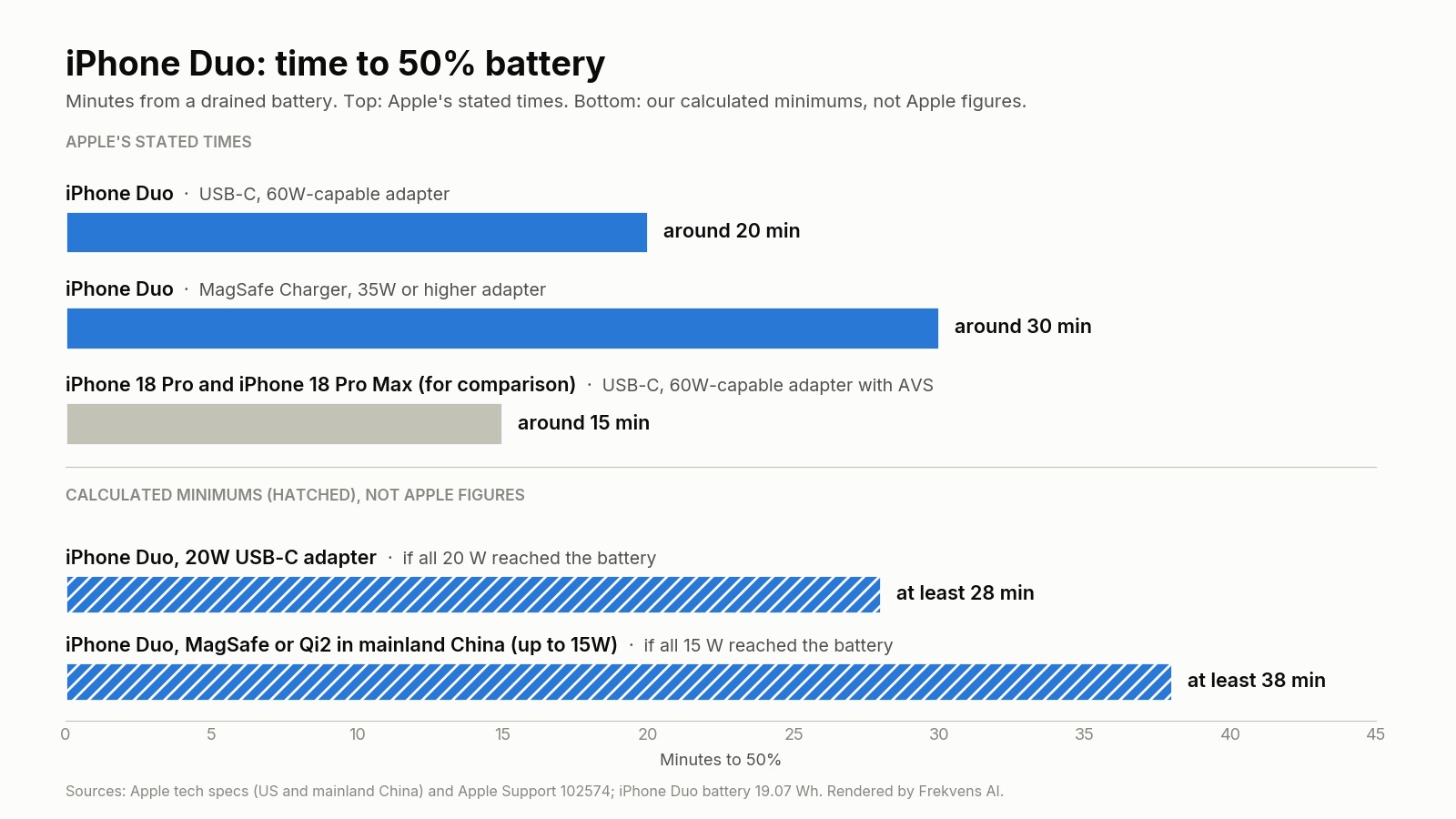
Apple's times come from drained preproduction iPhone Duo units in July 2026, tested with the phone open ("open configuration") and timed from the Apple logo at startup. Apple used the 40W Dynamic Power Adapter with 60W Max, with either the USB-C Charge Cable or a MagSafe Charger. It gives no time for charging the iPhone Duo closed, and adds that charge time varies with adapter, settings, usage and environmental factors.
How many watts does the iPhone Duo charge at?
Apple does not say. It publishes which adapter you need and how long 0 to 50% takes, not the power the phone takes in. "60W-capable" describes the adapter.
What we can calculate is the average power Apple's time implies: half the battery's energy divided by the time.
- Battery: 19.07 Wh in total, from two cells of 11.567 Wh and 7.506 Wh (sources below).
- Half the battery: 9.54 Wh.
- Apple's time: around 20 minutes, a third of an hour.
- Average power into the battery: 9.54 Wh × 3 = 28.6 W, about 29 W.
Apple rounds its time, so each minute more or less than 20 moves the result by about 5% (19 minutes gives 30.1 W, 21 minutes 27.2 W). This is an average over the first half of the charge, not a peak, and not what the adapter puts out. The same method gives about 19 W for MagSafe: 9.54 Wh in around 30 minutes.
What is the battery capacity of the iPhone Duo?
The iPhone Duo has two batteries with a rated capacity of 4,883 mAh together, according to Apple's EU product information sheet for model A3720. Apple publishes only that mAh figure. The watt-hours come from teardown videos and regulatory filings, as reported by MacRumors and Macwelt:
| Battery | Capacity | Source |
|---|---|---|
| Both batteries, rated | 4,883 mAh | Apple product information sheet and EU EPREL database (model A3720) |
| Larger cell | 2,962 mAh, 11.567 Wh | MacRumors (teardown videos), Macwelt (Wh) |
| Smaller cell | 1,921 mAh, 7.506 Wh | MacRumors (teardown videos), Macwelt (Wh) |
| Both cells added | 4,883 mAh, 19.073 Wh | Sum of the two rows above |
The two cells add up exactly to Apple's 4,883 mAh. MacRumors, citing the teardown videos, gives the cells as 11.56 Wh and 7.5 Wh. 19.073 Wh ÷ 4.883 Ah = 3.906 V, close to the 3.909 V implied by the iPhone 18 Pro battery label in iFixit's teardown (16.76 Wh, 4,288 mAh).
Apple lists no SIM tray for any iPhone Duo model, so there is no SIM-tray version with a smaller battery, as there is for the iPhone 18 Pro. Apple's 4,883 mAh is the figure for model A3720, the model registered in the EU. Apple gives no capacity for the other iPhone Duo model numbers (A3447, A3719, A3721); our calculations assume they have the same battery.
How the two batteries share the charge is not published. Apple's specs list "Dual built-in rechargeable lithium-ion batteries", and its iPhone Duo page describes a dual-battery architecture that "intelligently charges your system". Apple does not say whether both cells charge at the same rate, or how the battery percentage on screen relates to each cell.
Does the iPhone Duo charge as fast as the iPhone 18 Pro?
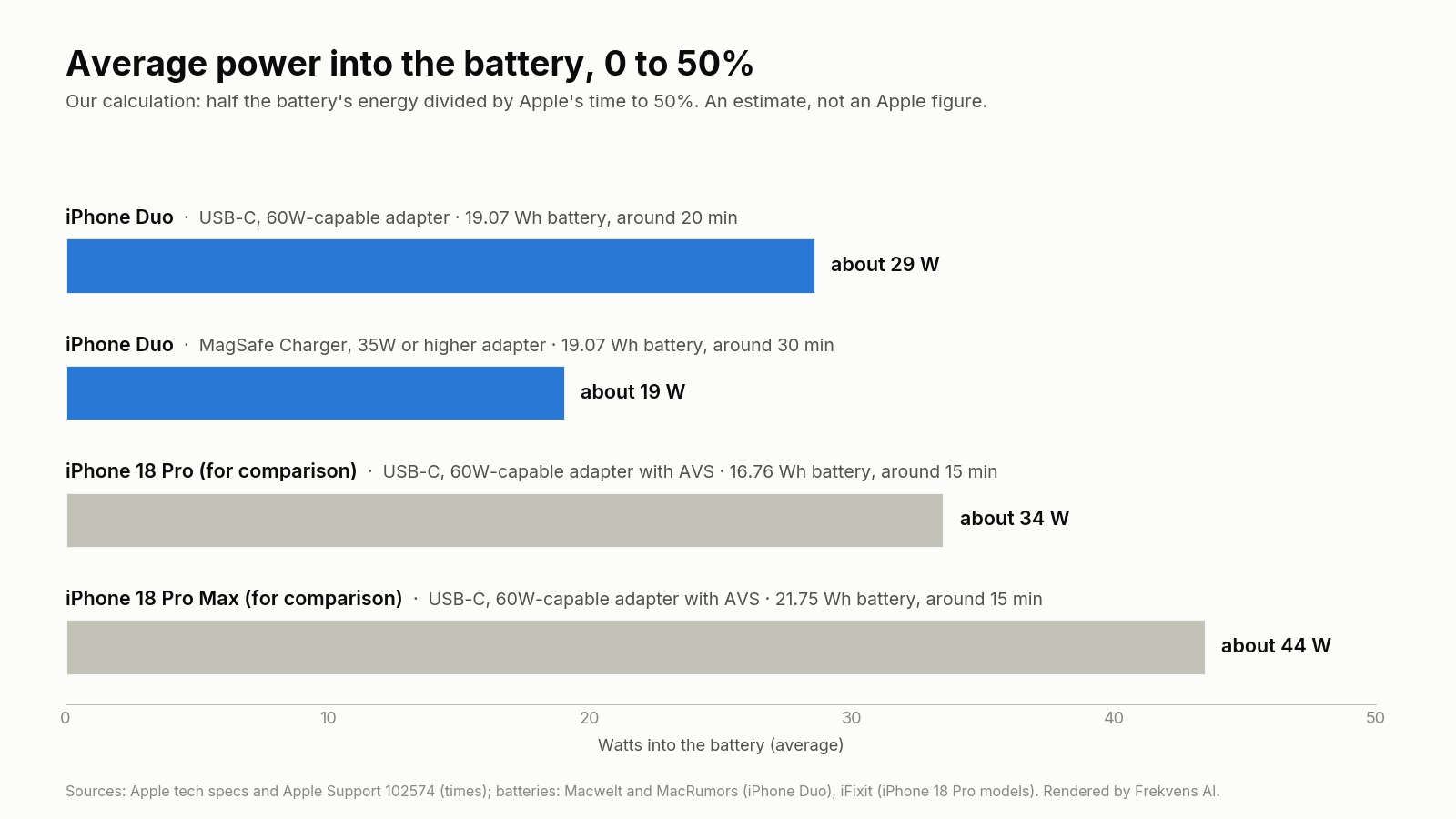
No. Apple gives the iPhone Duo around 20 minutes to 50%, and the iPhone 18 Pro and iPhone 18 Pro Max around 15 minutes. Apple timed all three with the same 40W Dynamic Power Adapter with 60W Max.
The iPhone Duo battery is about 14% larger than that of the iPhone 18 Pro without a SIM tray (19.07 Wh against 16.76 Wh) and about 12% smaller than that of the US iPhone 18 Pro Max (21.75 Wh). Its average of about 29 W is still the lowest of the three: the same method gives about 34 W for the iPhone 18 Pro and about 44 W for the iPhone 18 Pro Max. More in iPhone 18 Pro charging speed.
What charger does the iPhone Duo need?
For Apple's 20 minutes: a 60W-capable (or higher) USB-C power adapter, with the USB-C cable from the box. Apple's own option is the 40W Dynamic Power Adapter with 60W Max, the adapter it tested with. It costs $39 in Apple's US store, and its product page says it has Adjustable Voltage Supply (AVS).
USB Power Delivery (USB PD) is the standard from the USB Implementers Forum (USB-IF) that lets a USB-C charger and the device agree on more power than basic USB provides, "providing more flexible power delivery along with data over a single cable". Its AVS mode lets the device being charged request intermediate voltages instead of only the charger's fixed voltage steps.
Apple's pages disagree on whether the iPhone Duo needs AVS:
- The support article "Fast charge your iPhone" lists the iPhone Duo together with the iPhone 18 Pro models, and asks third-party adapters for AVS and USB-PD 3.2.
- The iPhone Duo tech specs ask for a "60W-capable adapter or higher" and do not mention AVS. Their footnote, repeated in the support article, asks for a 60W-capable USB-C cable and "USB PD power adapters". For the iPhone 18 Pro, the same places name AVS.
A 60W-capable adapter that lists both AVS and USB PD 3.2 meets every version. Apple gives no iPhone Duo time for an adapter without AVS.
| Charger | iPhone Duo, to 50% | Where the number comes from |
|---|---|---|
| 60W-capable USB-C adapter | About 20 min (about 29 W into the battery) | Apple's time; watts calculated |
| MagSafe Charger + 35W or higher adapter | About 30 min (about 19 W into the battery) | Apple's time; watts calculated |
| Qi2 charger (up to 25W) | Not published | Apple gives the wattage only |
| 20W USB-C adapter | At least 28 min | Lower bound, calculated |
| MagSafe or Qi2 in mainland China (up to 15W) | At least 38 min | Lower bound, calculated |
Times from a drained battery to 50%. A lower bound is 9.54 Wh divided by the charger's watts, as if every watt reached the battery, so the real time can only be longer.
Is a 20W charger enough? Not for Apple's 20 minutes. A 20W adapter supplies at most 20 W, so even if every watt reached the battery, 0 to 50% would take at least 28 minutes. Apple publishes no iPhone Duo time for a 20W adapter.
What about a laptop charger? A USB-C laptop adapter of 60W or more that supports USB PD matches the wording of the iPhone Duo footnote, but not the AVS line in the support article. Check its spec sheet for AVS before you count on 20 minutes.
Which cable? The support article says to use the USB-C cable that came in the box. The footnote asks for a 60W-capable USB-C cable.
Does the iPhone Duo have MagSafe, and how fast is it?
Yes. Apple lists MagSafe wireless charging up to 25W and Qi2 wireless charging up to 25W for the iPhone Duo, with a magnet array and an alignment magnet. The details:
- For 50% in around 30 minutes, the tech specs and the support article say a MagSafe Charger and a 35W or higher adapter. The MagSafe Charger store page says the 30W USB-C Power Adapter. A 35W or higher adapter covers both.
- Apple tested with the MagSafe Charger models A3502 (1 m) and A3503 (2 m). The 1 m MagSafe Charger costs $39 in Apple's US store.
- Apple's mainland China tech specs list MagSafe and Qi2 at up to 15W for the iPhone Duo and give no MagSafe time. Apple gives no battery capacity for the mainland China model (A3721). If it has the same battery, 50% would take at least 38 minutes even if all 15 W reached the battery.
- Apple's support article on the MagSafe Charger (published September 18, 2026) does not list the iPhone Duo. It gives the iPhone 18 Pro models a 16W limit while USB-C accessories such as headphones are connected, and says nothing about the iPhone Duo.
Apple's 30 minutes works out to about 19 W reaching the battery on average, about 76% of the 25W peak. For Qi2, the Wireless Power Consortium says the original Qi2 charges at 15W and that Qi2 25W, launched in July 2025, carries nearly 70% more power. Apple's iPhone Duo page names Qi2 25W chargers but gives no Qi2 time, so for the 25W figure look for a charger certified as Qi2 25W.
Why does charging slow down after 80%?
Apple says the iPhone gradually reduces the charging current as the battery nears full, and that software might limit charging above 80% when the battery is too warm. On its iPhone Duo page, Apple adds that Optimized Battery Charging delays the final charge, from 80% to 100%, until you are likely to need it. Apple quotes only 0 to 50% for the iPhone Duo; more in our articles on charging an iPhone overnight and slow iPhone charging.
How to check the charging speed of your own iPhone Duo
- Start low. Apple's figure covers 0 to 50%, so start below about 20% and follow the climb to 50%. Readings above 80% tell you about the slowdown, not the charger.
- Keep the setup the same. Same cable, same adapter, room temperature. Apple timed the iPhone Duo open, so compare runs with the phone open each time, or closed each time.
- Do the math by hand. Note the time at two battery percentages. Average power ≈ 19.07 Wh × (end % − start %) ÷ hours. Worked example, not a measurement: 20% to 50% in 12 minutes gives 19.07 × 0.30 ÷ 0.2 = 28.6 W. This assumes the percentage on screen stands for both batteries together, which Apple has not spelled out.
- Or let an app do the math. Watt Charging Speed (our app) for iPhone and iPad does the same math from the battery level and your model's battery size, so it estimates the power reaching the battery. From version 1.5 it counts both iPhone Duo batteries together. It is not a USB power meter and does not see momentary peaks. Because iOS reports the battery level in 5% steps, the first number needs up to about 10% of charging, with the app open on screen.
- Check against the estimate. With a 60W-capable adapter, about 29 W on the way to 50% is in line with Apple's 20 minutes (our estimate, not an Apple figure); on a MagSafe Charger with a 35W adapter, about 19 W is in line with Apple's 30 minutes. Much less? Check the cable, the adapter's AVS and USB PD support, and the phone's temperature.
Questions people ask
What charging port does the iPhone Duo have?
USB-C. Apple's tech specs list a USB-C connector with support for charging, DisplayPort and USB 3 (up to 10Gb/s).
Does the iPhone Duo come with a charger?
No. Apple lists the iPhone and a USB-C Charge Cable (1 m) in the box, with no power adapter.
Is the MagSafe Duo Charger made for the iPhone Duo?
No. Apple says the MagSafe Duo Charger is designed for iPhone 12, iPhone 13 and iPhone 14 models and Apple Watch, at up to 14W peak. It is a different accessory with a similar name; Apple's MagSafe Charger store page is the one that lists the iPhone Duo.
Is it safe to leave an iPhone Duo on the charger overnight?
Apple says an iPhone stops charging when the battery is full, so it is safe to leave it connected overnight; charging resumes if the level drops below 95%. More in Is it bad to charge your iPhone overnight?
Sources
- Apple — iPhone Duo Technical Specifications, checked November 5, 2026
- Apple (mainland China) — iPhone Duo Technical Specifications, in Chinese, checked November 5, 2026
- Apple — iPhone Duo, checked November 5, 2026
- Apple Support — Fast charge your iPhone (published October 22, 2026), checked November 5, 2026
- Apple Support — How to use your MagSafe Charger with iPhone (published September 18, 2026), checked November 5, 2026
- Apple — MagSafe Charger (1 m), checked November 5, 2026
- Apple — 40W Dynamic Power Adapter with 60W Max, checked November 5, 2026
- Apple Support — Identify your iPhone model, checked November 5, 2026
- Apple — Product Information Sheet, model A3720 (PDF), checked November 5, 2026
- EU EPREL — Apple A3720, checked November 5, 2026
- MacRumors — iPhone Duo Teardowns Reveal Two Batteries and More (October 24, 2026), checked November 5, 2026
- Macwelt — So groß sind die Batterien des iPhone Duo (October 19, 2026), in German, checked November 5, 2026
- Apple — iPhone 18 Pro and 18 Pro Max Technical Specifications, checked November 5, 2026
- iFixit — iPhone 18 Pro and Pro Max teardown, checked November 5, 2026
- Apple Support — Charge and maintain your iPhone battery, checked November 5, 2026
- Apple Support — How to use MagSafe Duo Charger with your iPhone and Apple Watch, checked November 5, 2026
- Wireless Power Consortium — Qi wireless charging, checked November 5, 2026
- USB-IF — USB Charger (USB Power Delivery), checked November 5, 2026
- frekvens.ai — Watt Charging Speed (our app) support page (how the app estimates), checked November 5, 2026
How this article was made: Written with AI and checked against the sources above by an automated editorial step; published by Frekvens AI. No measurements of our own are used: the figures marked as calculated are estimates from Apple's published times and the battery capacities in the sources, and the charts were rendered by script from the same numbers. The image at the top is an AI-generated illustration, not a photo of the iPhone Duo. Apple has not sponsored or approved this article. iPhone and MagSafe are trademarks of Apple Inc., registered in the U.S. and other countries and regions. App Store is a service mark of Apple Inc.