
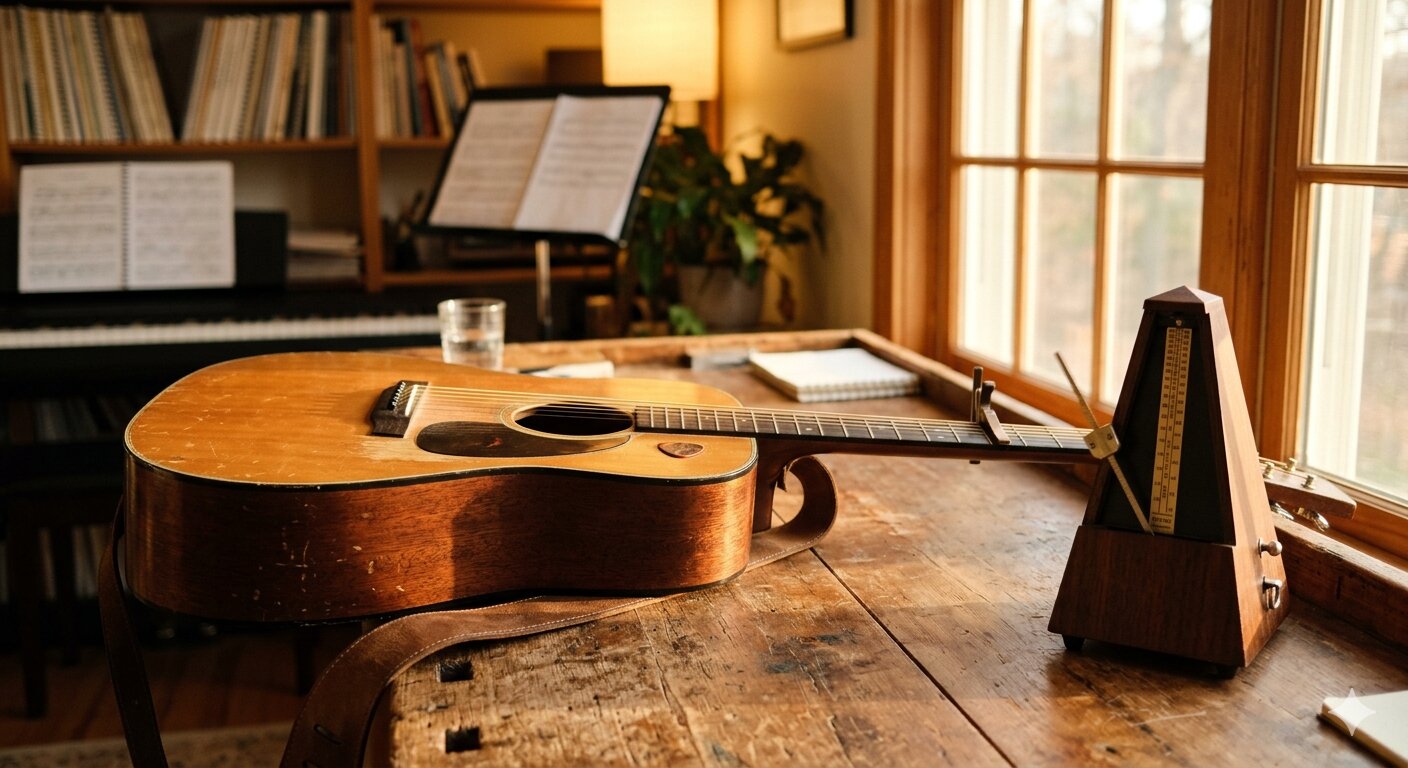
Ask any guitar teacher what separates good players from great ones, and the answer is almost always the same: timing. You can know every chord and scale in the book, but if your rhythm is off, everything sounds wrong. And the single best tool for developing solid timing is a metronome.
The problem is that most guitarists either skip the metronome entirely or use it wrong. Here's how to actually practice with one — and why it makes such a difference.
Why Timing Matters More Than Speed
Beginners often focus on learning to play fast. But speed without timing is just noise. A guitarist who plays a simple chord progression perfectly in time will always sound better than someone who shreds through a solo while rushing and dragging.
Good timing means every note lands exactly where it should — not a little early, not a little late. A metronome gives you an objective reference to practice against, so you can hear when you're off and gradually tighten up your playing.
Start Slower Than You Think
The biggest mistake with metronome practice is starting too fast. If you're learning a new chord change or riff, set the metronome to a tempo where you can play it perfectly every time — even if that's painfully slow.
A good starting point for most exercises is 60 BPM (beats per minute). At this tempo, each click is one second apart, giving you plenty of time to think about what your fingers are doing. Once you can play the passage cleanly at 60 BPM for a full minute without mistakes, bump it up by 5 BPM.
This gradual approach builds clean muscle memory. Practicing fast with mistakes just reinforces those mistakes.
Practice Chord Changes with a Click
One of the best beginner exercises is switching between two chords on every click. Set the metronome to 60 BPM and switch between G and C, or D and A — whatever chords you're working on.
The goal is to land the new chord shape right on the beat, with all the strings ringing cleanly. If you're consistently late, slow down. Once it's solid, increase the speed by 5 BPM until you can switch at 100+ BPM without thinking about it.
Use It for Strumming Patterns
Strumming with a metronome forces you to keep a steady rhythm instead of speeding up and slowing down unconsciously. Try this:
- Set the metronome to 80 BPM
- Strum a simple down-up pattern: down on the beat, up between beats
- Focus on keeping your strumming hand moving consistently — it should feel like a pendulum
- Once comfortable, try adding muted strums or skipping upstrokes to create different patterns
The metronome keeps you honest. Without it, you'll naturally speed up during easy parts and slow down during hard parts — and you won't even notice.
Build Speed Gradually
Want to play a riff or solo faster? The metronome method works better than just "trying to play it fast." Here's the process:
- Find the fastest tempo where you can play the passage perfectly (no mistakes, no tension)
- Practice it at that tempo for 2–3 minutes
- Increase by 3–5 BPM
- If you start making mistakes, drop back down and spend more time at the lower tempo
- Repeat daily
Over a week or two, you'll be surprised how much faster you can play while still being clean. This method works because it builds speed through accuracy, not through sloppy repetition.
Metronome Apps for Guitar Practice
You don't need a physical metronome — your phone works great. A few apps that include a metronome alongside other guitar tools:
- StringKit — A guitar companion app with a built-in metronome, precision tuner, and a 168-chord library. Handy because you can switch between tuning, looking up a chord, and practicing with the metronome all in one place.
- Pro Metronome — A dedicated metronome app with different time signatures, accent patterns, and subdivisions. Good for more advanced rhythm work.
- Soundbrenner — A metronome with haptic feedback through the Apple Watch, so you can feel the beat without headphones. Useful for practicing in quiet settings.
Make It a Habit
Even five minutes of metronome practice per session will improve your timing noticeably within a few weeks. The key is consistency — it's better to do a short, focused metronome exercise every day than a long session once a week.
Your future bandmates, jam partners, and audience will hear the difference. Timing is the foundation that everything else is built on, and the metronome is how you build it.