
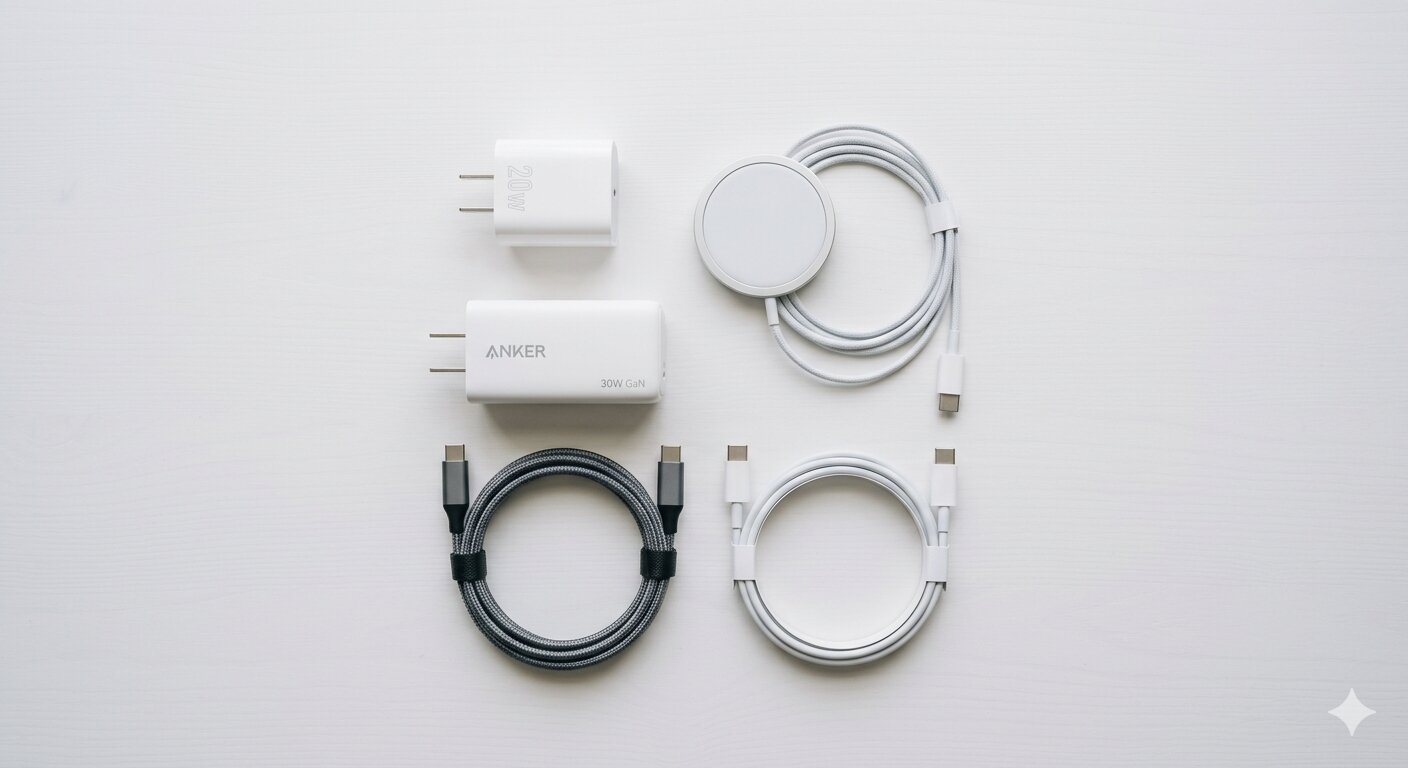
Walk into any electronics store and you'll find a wall of chargers ranging from $8 to $50, all claiming to work with your iPhone. Some are 5W, some are 30W, some have USB-A, others USB-C. The packaging tells you very little about what actually matters. So how do you pick the right one?
It's simpler than it looks. Here's what you need to know.
Wattage: How Much Do You Actually Need?
The wattage of a charger determines how fast it can charge your iPhone. Here's a quick breakdown:
- 5W — The old Apple standard. Charges an iPhone from 0 to 100% in roughly 3–3.5 hours. Works, but slow by today's standards.
- 20W — The sweet spot for most people. Supports fast charging on iPhone 8 and later, getting you to about 50% in 30 minutes. This is what Apple recommends.
- 30W+ — Useful if you also charge an iPad or MacBook Air with the same charger. For the iPhone alone, anything above 27W won't charge faster — that's the current peak the iPhone accepts.
For most people, a 20W charger is the right choice. It's fast, affordable, and small enough to travel with. If you want one charger for multiple devices, 30W gives you more flexibility without a big price jump.
USB-C Is the Standard Now
Since iPhone 15, all iPhones use USB-C. If you're buying a new charger, get one with a USB-C port. USB-A chargers still work with older Lightning cables, but they typically max out at lower wattages and the connector is being phased out across the industry.
For the cable itself, make sure it supports the wattage you need. Not all USB-C cables are equal — cheap cables sometimes limit power delivery. Look for cables rated for at least 60W (even for a 20W charger) to avoid any bottleneck.
MagSafe and Wireless: Worth It?
MagSafe chargers are convenient — they snap magnetically onto the back of your iPhone and charge wirelessly at up to 25W (on iPhone 16 models). They're great for nightstands and desks where you want to drop your phone and go.
The tradeoff is speed. Even at 25W, MagSafe is slower than a wired 20W charger for getting to 50% quickly, because wireless charging generates more heat and the phone throttles to protect the battery. If speed matters most, wired is still king. If convenience matters more, MagSafe is a solid choice.
Standard Qi wireless chargers top out at 7.5W for iPhones — noticeably slower than both MagSafe and wired. They work in a pinch, but they're not ideal as your primary charger.
Brand: Does It Matter?
You don't need to buy Apple's own charger, but you should buy from a reputable brand. Look for chargers that are MFi-certified (Made for iPhone) or from well-known accessory makers like Anker, Belkin, or Ugreen. These brands use proper safety circuits and deliver consistent power.
Avoid the cheapest no-name chargers, especially from marketplace sellers with no reviews. A poorly made charger can deliver inconsistent power, charge slowly despite its rated wattage, or in rare cases overheat. Saving $5 isn't worth the risk.
How to Check What Your Charger Actually Delivers
Here's something most people don't realize: the wattage printed on a charger is its maximum capability, not necessarily what your iPhone is receiving. Your actual charging speed depends on the charger, the cable, the battery level, the temperature, and even whether the screen is on.
If you want to know what's really happening, there are a few ways to check:
- Watt Charging Speed — Shows real-time charging wattage on your iPhone so you can see exactly how fast your charger is performing. Useful for comparing chargers or verifying that a new cable isn't limiting your speed.
- Ampere — Displays battery charge rate and health information. A simple way to monitor charging status over time.
- Shortcuts app — You can build an automation that logs battery percentage at intervals to estimate charge speed, though it takes more setup.
Testing your chargers is especially useful if you've accumulated a drawer full of them over the years. You might discover that the one you've been using is significantly slower than another one sitting right next to it.
Quick Buying Guide
Here's a simple decision tree:
- Just need a charger for your iPhone? Get a 20W USB-C charger from Anker, Belkin, or Apple. Pair it with a USB-C cable.
- Want one charger for iPhone + iPad? Go with 30W USB-C. Same size as a 20W in most cases.
- Nightstand or desk charging? A MagSafe puck is great for convenience. Make sure the power adapter supports at least 20W to get full MagSafe speed.
- Traveling? A 30W GaN charger is compact, lightweight, and powerful enough for all your devices. GaN (gallium nitride) chargers run cooler and are smaller than traditional chargers at the same wattage.
The Bottom Line
A 20W USB-C charger from a reputable brand is the right choice for most iPhone users. It's fast, affordable, and future-proof. Don't overthink it — but don't grab the cheapest option either. Your phone charges every single day, so it's worth getting a charger that does the job properly.