
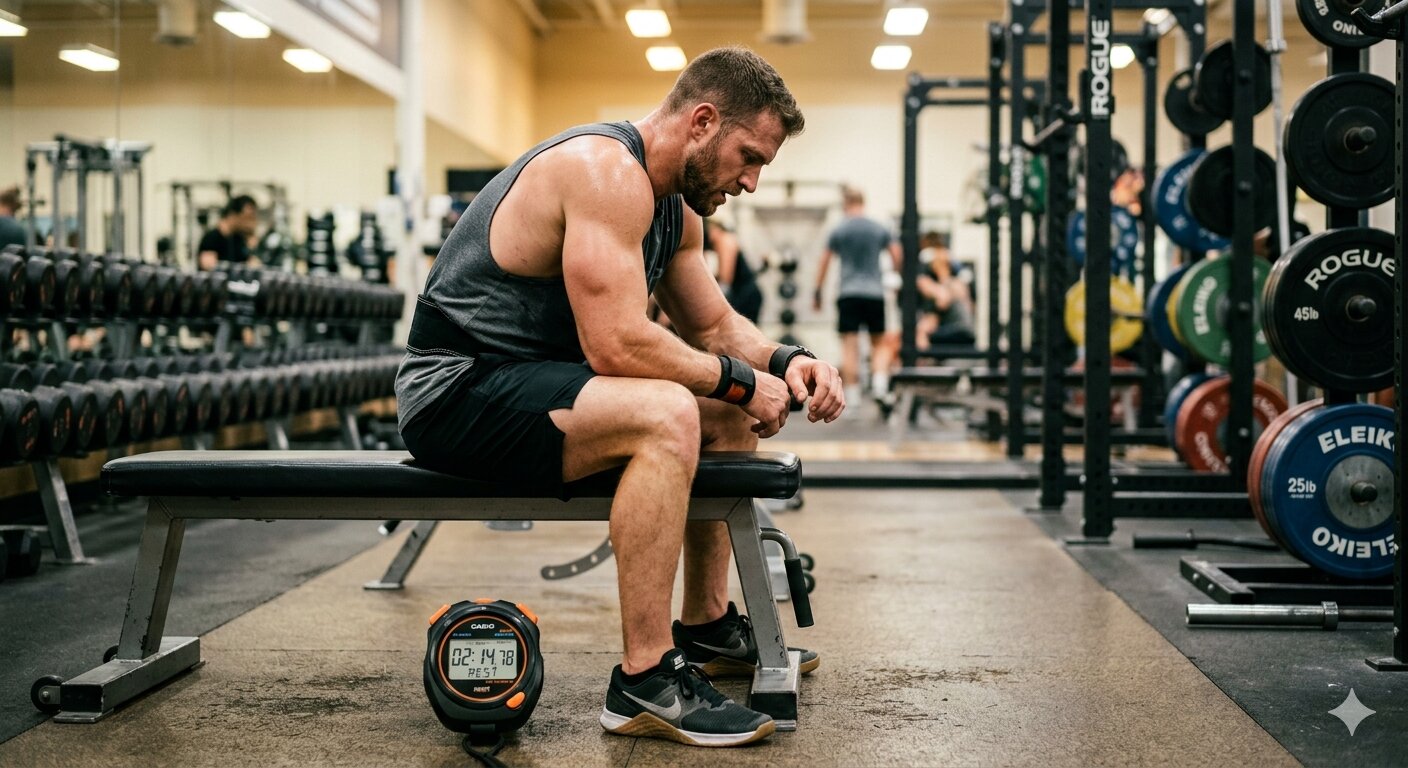
You finish a hard set of squats, rack the bar, and then what? Scroll your phone for a minute? Five minutes? Until someone asks if you're still using the rack? Rest periods are one of those training variables that most people either ignore completely or overthink. The truth is simpler than you'd expect — but it does depend on what you're training for.
The Short Answer
Here's the general guideline based on current exercise science:
- Strength (heavy, low reps): 3–5 minutes between sets
- Muscle growth (moderate weight, 6–12 reps): 1.5–3 minutes between sets
- Endurance (light weight, high reps): 30–90 seconds between sets
These ranges come from decades of research on how your muscles recover energy between efforts. But let's break down why each range matters.
Why Strength Training Needs Longer Rest
When you lift heavy — think 1–5 reps near your max — your muscles rely on a system called phosphocreatine for quick energy. This system is powerful but takes time to recharge. Studies show it takes about 3–5 minutes to fully restore phosphocreatine after an all-out effort.
If you cut your rest short during heavy sets, you won't be able to lift as much on the next set. Over time, that means less total weight moved and slower strength gains. For exercises like squats, deadlifts, and bench press at heavy loads, patience between sets pays off.
The Sweet Spot for Muscle Growth
For hypertrophy — building muscle size — the research has shifted over the years. Older advice recommended short rest periods (60–90 seconds) to maximize metabolic stress. But more recent studies suggest that resting 2–3 minutes produces equal or better muscle growth, because you can do more total reps with heavier weight.
The practical takeaway: rest long enough to perform your next set with good form and close to the same number of reps. If you did 10 reps on your first set and can only manage 5 after a 60-second rest, you're cutting yourself short. Resting another minute could make a real difference in your results.
When Short Rest Makes Sense
Shorter rest periods (30–90 seconds) are useful when your goal is muscular endurance or conditioning. Circuit training, supersets, and high-rep sets benefit from shorter rest because the goal is to challenge your cardiovascular system and build stamina, not maximize the weight on the bar.
Short rest also makes sense for isolation exercises — like bicep curls or lateral raises — where the load is lighter and full recovery between sets isn't as critical.
Common Mistakes With Rest Periods
The most common mistake isn't resting too long or too short — it's being inconsistent. If you rest 2 minutes one week and 4 minutes the next on the same exercise, it's hard to know whether your strength actually improved or you just had more recovery time.
Tracking rest periods alongside your sets and reps gives you a clearer picture of real progress. A few apps that make this easier:
- PR AI — Tracks your sets, reps, and weight with a built-in rest timer. Uses AI to suggest when to increase weight or adjust your program based on your actual performance.
- Strong — A popular workout logger with a rest timer that starts automatically between sets. Clean interface and easy to use.
- Hevy — Combines workout tracking with a social feed. Good for people who like sharing progress with a community.
How to Find Your Ideal Rest Time
The research provides ranges, but the best rest period for you also depends on your fitness level, the specific exercise, and how you feel on a given day. Here's a simple rule of thumb: rest until you feel ready to give the next set a solid effort, but not so long that you've cooled down completely.
For compound lifts (squats, deadlifts, rows, presses), lean toward the longer end. For isolation work (curls, flyes, extensions), you can usually get away with shorter rest. And as you get more experienced, you'll develop a feel for what your body needs.
The Bottom Line
Rest periods aren't just dead time — they're part of your training. Match your rest to your goal: longer for strength, moderate for muscle growth, shorter for endurance. Be consistent so you can track real progress, and don't feel guilty about resting 3 minutes between heavy sets. Your muscles need it, and your results will show it.