
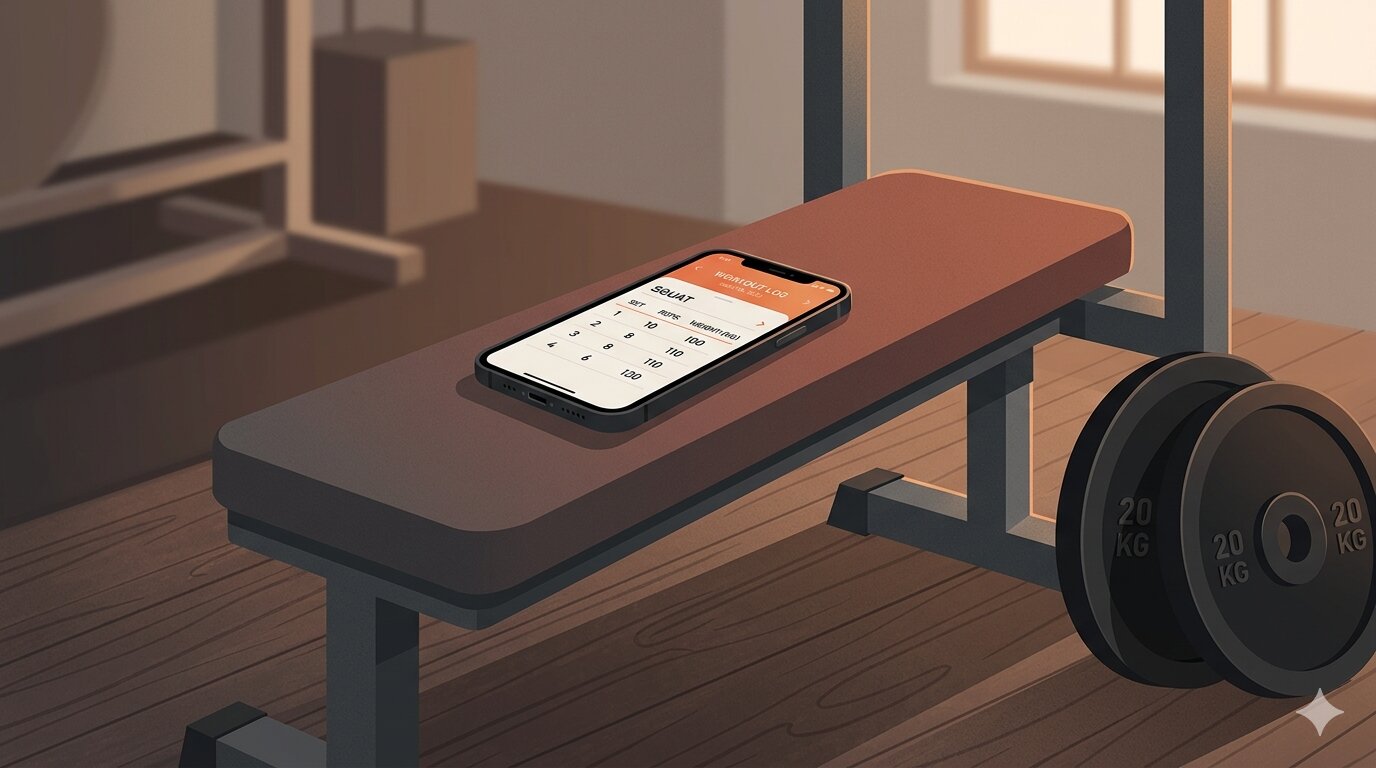
You've probably been there: squinting at your notes app between sets, trying to remember if you did 70 kg or 75 kg last week. Or worse — not tracking at all and wondering why you've been stuck at the same weight for months.
A good workout tracker doesn't just record numbers. It shows you whether you're actually progressing, helps you plan what to do next, and removes the mental load of remembering everything. The question is which one to use — because the App Store is packed with options.
Why You Need a Dedicated Tracker (Not Just Notes)
A plain text note can hold your workout data, but it can't do anything with it. A proper strength training app gives you:
- Progression charts — See at a glance if your squat has gone up over the past two months or flatlined.
- History per exercise — Instantly look up what you lifted last session for any movement, without scrolling through pages of text.
- Rest timers — So you're not guessing or getting lost on your phone between sets.
- Volume tracking — Total sets, reps, and tonnage per workout and per week — the data that actually predicts muscle growth.
If you're serious about getting stronger, tracking is non-negotiable. The tool you use matters less than being consistent with it — but a good app makes consistency a lot easier.
What Makes a Good Strength Training App?
There are hundreds of fitness apps, but for pure strength training, here's what to prioritize:
- Fast logging — You should be able to log a set in under 5 seconds. If the app makes this slow or clunky, you'll stop using it.
- Exercise library — It should include common barbell, dumbbell, and machine exercises out of the box, plus let you add custom ones.
- Progress visualization — Charts for weight, volume, and estimated 1RM over time. This is where the real value is.
- Program support — If you follow a structured program (like 5/3/1, PPL, or Upper/Lower), the app should let you build and launch templates.
Best Strength Training Apps for iPhone
Here are four apps worth looking at, each with a different strength:
- Strong — The gold standard for clean, fast workout logging. Strong has a minimal interface that lets you log sets with weight and reps in seconds. It includes progression charts, rest timers, and program templates. Free for up to three custom routines, then a subscription to unlock unlimited.
- Hevy — Similar to Strong but with a generous free tier that includes unlimited workouts and exercises. Hevy adds social features — you can follow friends, share workouts, and compare progress. Great if motivation from others helps you stay consistent. Free with optional pro upgrade.
- Fitbod — Takes a different approach by generating workouts for you based on your history, recovery, and available equipment. Good if you don't want to program your own training and prefer the app to tell you what to do. Subscription-based.
- PR AI — Focuses on manual logging with AI-powered progression recommendations. You log sets with weight, reps, and RPE, and the app suggests when to increase load based on your trends. Includes progression charts with volume and estimated 1RM tracking, plus the ability to create and launch training programs. One-time purchase, no subscription.
Strong and Hevy are the most popular choices for manual loggers. Fitbod suits people who want auto-generated workouts. PR AI sits somewhere in between — you control your programming, but it nudges you when the data says you're ready to push harder.
How to Get the Most Out of Any Tracker
Whichever app you pick, these habits will make your data more useful:
- Log every working set. Skip warm-ups if you want, but don't skip working sets. Gaps in data make progress hard to read.
- Be honest about reps. That half-rep doesn't count. Accurate data leads to accurate insights.
- Review your progress weekly. Don't just log and forget. Spend two minutes each week looking at your charts. Are your numbers going up? If not, something needs to change.
- Use RPE or RIR if the app supports it. Weight and reps alone don't tell the full story. Rating how hard a set felt (RPE) helps you gauge when you're ready to add load.
The Bottom Line
The best workout tracker is the one you actually open every session. Try a couple, see which logging flow feels fastest, and stick with it. The data compounds over time — and six months from now, you'll have a clear picture of how far you've come.