
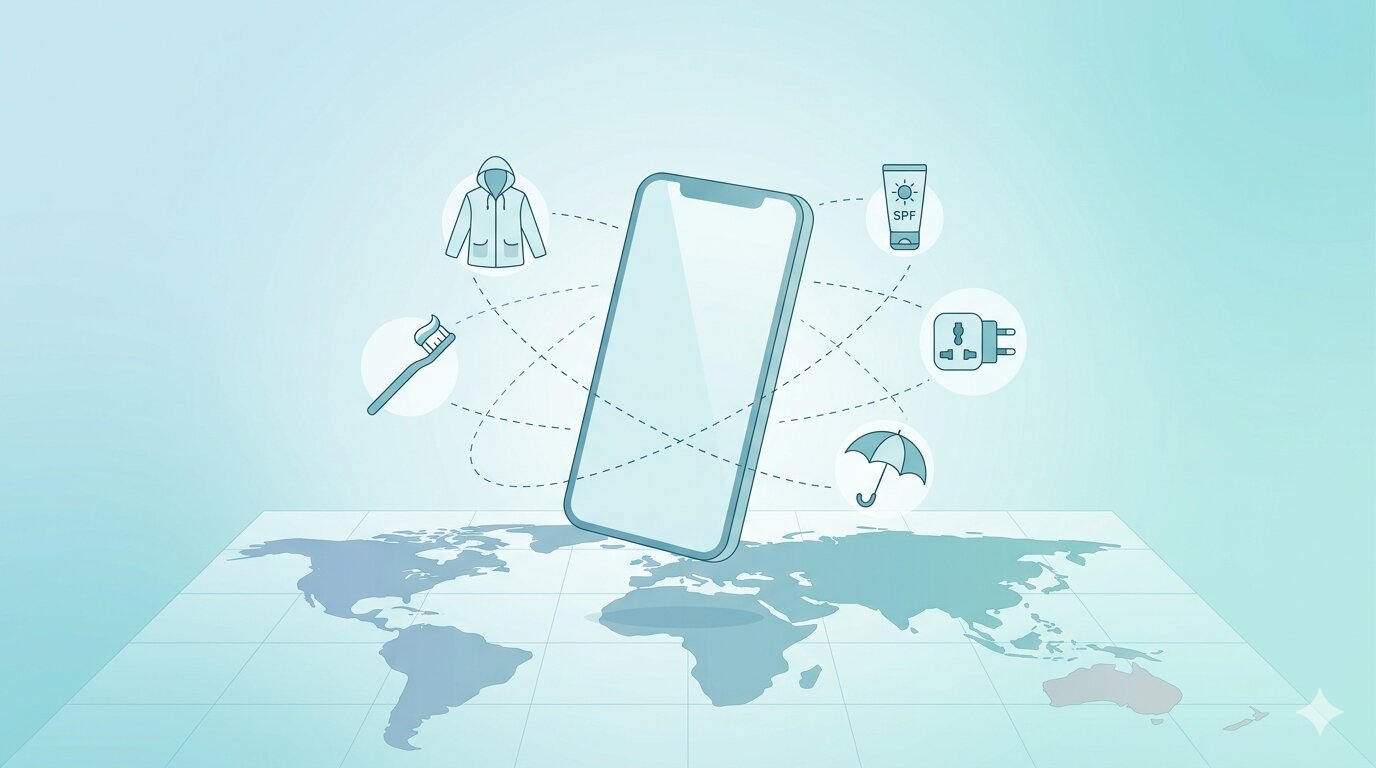
You're at the airport, bags checked, boarding pass ready — and then it hits you. You forgot your adapter. Or your rain jacket. Or the medication you promised yourself you wouldn't forget this time.
It happens to almost everyone, and it's almost always preventable. The problem isn't that you're forgetful — it's that packing from memory is unreliable. A good packing list app takes the guesswork out of it by building a checklist based on where you're going, how long you'll be there, and what you'll be doing.
Why a Packing App Beats a Notes List
Sure, you could write a list in your notes app. But a dedicated packing app does things a plain text list can't:
- Weather-aware suggestions — It checks the forecast and tells you to bring a raincoat or sunscreen before you think of it.
- Activity-based lists — Going hiking? Swimming? To a business meeting? The list adjusts accordingly.
- Reusable templates — Once you've built a solid list, you can reuse it for similar trips without starting from scratch.
- Quantity calculations — A week-long trip needs more socks than a weekend getaway. Good apps do that math for you.
The result is a list that's personalized, complete, and ready in seconds instead of the 20 minutes you'd spend staring at your closet trying to remember what you forgot last time.
What to Look for in a Packing List App
Not all packing apps are created equal. Here's what separates the useful ones from the gimmicky:
- Smart suggestions — The app should recommend items based on your trip, not just give you an empty checklist.
- Easy editing — You should be able to quickly add, remove, or check off items without friction.
- Offline access — You need your list at the airport, in the hotel, and on the road — not just when you have Wi-Fi.
- Sync across devices — If you plan on your laptop but check off items on your phone, syncing matters.
Best Packing List Apps for iPhone
Here are three solid options, each with a slightly different approach:
- PackPoint — One of the most established packing apps. You enter your destination, travel dates, and planned activities, and it generates a list based on weather and trip type. Supports multiple trips and lets you customize suggestions. Free with a pro upgrade for extra features like shared lists.
- Packr — A clean, visual packing app that pulls weather forecasts for your destination and suggests items accordingly. Supports packing for multiple travelers — handy if you're packing for kids too. Free with a one-time premium upgrade.
- Auto Pack — Takes an AI-first approach: describe your trip in plain language (e.g., "5 days in Tokyo in April, business and sightseeing") and it generates a full packing list ranked by relevance. It learns your personal item library over time and adjusts quantities based on trip length. iCloud sync across devices.
PackPoint and Packr use a form-based approach where you select activities from a list. Auto Pack leans on AI to interpret a free-text description. All three handle the core job well — pick the one whose workflow feels most natural to you.
Tips for Packing Smarter (With or Without an App)
Whatever tool you use, these habits make a difference:
- Pack the night before, not the morning of. Rushing leads to forgetting. Give yourself time to think.
- Lay everything out first. Don't pack directly into the suitcase. Spread items on the bed so you can see what's missing.
- Use packing cubes. They compress clothes, keep things organized, and make it easy to see what you've packed at a glance.
- Keep a "travel essentials" bag. A small pouch with a charger, adapter, earplugs, and toiletries that's always packed and ready to go.
- Check your list twice — once before zipping up, once before leaving the hotel. The return trip is where most things get left behind.
The Best System Is the One You Actually Use
A packing list only works if you use it consistently. Whether that's an app, a spreadsheet, or a sticky note on your suitcase — the point is to stop relying on memory alone. Your brain has enough to think about before a trip. Let a list handle the boring part.