
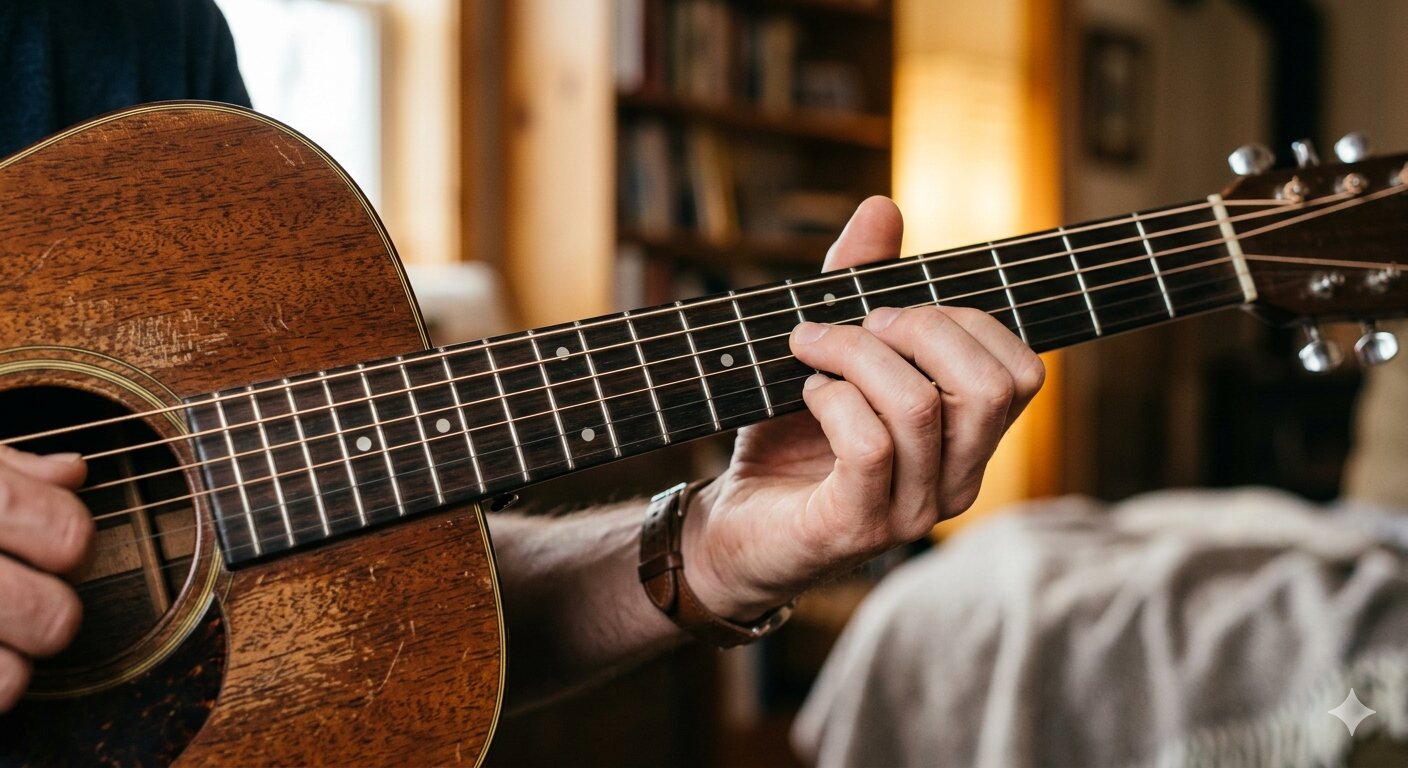
When you first pick up a guitar, the number of possible chords can feel overwhelming. The good news is you don't need to learn hundreds of them to start playing songs. In fact, just eight open chords will unlock a huge number of popular songs across almost every genre.
Here are the chords to focus on first, why they matter, and how to practice them efficiently.
The Essential 8 Open Chords
Open chords use a mix of fretted notes and open strings, making them easier to play than barre chords. These eight are the foundation of guitar playing:
- E minor (Em) — Often the very first chord beginners learn. Only two fingers, and it sounds full and rich.
- A minor (Am) — Another easy minor chord. Three fingers, all clustered together on the first two frets.
- C major (C) — One of the most common chords in popular music. A bit of a stretch for new players, but essential.
- D major (D) — Bright and cheerful. Uses three fingers on the top four strings.
- G major (G) — A big, full-sounding chord that spans all six strings. Takes some finger stretching at first.
- A major (A) — Three fingers packed tightly on the second fret. Shows up in countless songs.
- E major (E) — Similar shape to Am, just shifted by one string. Strong, full sound.
- D minor (Dm) — A slightly melancholy version of D. Rounds out your basic chord vocabulary.
With just these eight chords, you can play thousands of songs. Many popular hits use only three or four of them.
How to Practice Chord Changes
Knowing the shapes is only half the battle. The real skill is switching between chords smoothly without pausing. Here's how to build that skill:
- The one-minute drill: Set a timer for 60 seconds and switch back and forth between two chords as many times as you can. Count your clean switches. Try to beat your score each day.
- Anchor fingers: When switching between certain chords, one or more fingers can stay in the same spot. For example, switching from C to Am — your first finger stays on the first fret of the B string. Look for these shortcuts.
- Slow and clean first: Speed comes from accuracy, not the other way around. If your switches are buzzy or muted, slow down until every string rings clearly, then gradually speed up.
Use a Metronome
Once you can switch between chords cleanly, add a metronome. Start at a slow tempo — 60 BPM is a good starting point — and strum on each beat while changing chords every four beats. This builds the rhythmic consistency you'll need for playing actual songs.
As you get comfortable, bump the tempo up by 5–10 BPM. Within a few weeks, you'll be switching chords at speeds that felt impossible when you started.
Learn the Chord Diagrams
Guitar chords are usually written as diagrams showing which fingers go where on the fretboard. Learning to read these is an essential skill — it means you can pick up any new chord from a chart without needing a video tutorial.
A few apps can help you learn and reference chord shapes:
- StringKit — Includes a library of 168 chord diagrams alongside a precision tuner and metronome. Handy for looking up chord shapes and practicing timing in the same app.
- Chords & Scales — Extensive chord reference with audio playback so you can hear what each chord should sound like.
- Yousician — Interactive lessons that listen to your playing and give real-time feedback. Good for structured practice if you prefer guided learning.
Having a chord reference on your phone means you can practice anywhere — even without an internet connection.
What Comes After the Basics?
Once you're comfortable with these eight chords, the next steps are:
- Learn a few songs: Pick simple songs that use chords you already know. Playing actual music keeps practice fun and gives your chord changes a real-world workout.
- Add F major: The F chord is the first barre chord most players tackle. It's harder than open chords, but it opens up many more songs.
- Try strumming patterns: Move beyond simple downstrokes and experiment with up-down patterns to make your playing sound more musical.
The Bottom Line
You don't need to master every chord to start making music. Learn these eight open chords, practice switching between them cleanly, and start playing songs as soon as possible. The more you play real music, the faster your fingers will learn to move. Every guitarist started exactly where you are — the difference is just practice and time.